
Letters to Joel Walker


Letters to (mostly) Joel Walker:
Letter to J. Walker and J.M. Armstrong from William Walker, U. Sandusky – April 25, 1842
William says that he had a long chat with Henry Jacquis about the "grand conspiracy," and William believes that the discussion shows the "base and craven disposition of the man who now heads our nation." Mrs. Lewis is in Upper Sandusky on a visit, and she reports that Miss Emma Carey is not doing well and "must die in a short time." William Clark and his family recently arrived from Canada, and Clark believes that others will follow shortly. Henry Jacquis and George Armstrong were supposed to send a letter to Tauroumee but they have not arrived yet, perhaps due to a violent thunderstorm that has just passed through the area. William says that the bad weather was created by the "storm King Espy of your city." William is probably referring to James Pollard Espy (1785-1860), who was a meteorologist that worked for the government in Washington D.C.
Letter to Joel Walker from William Walker, U. Sandusky – July 10, 1842
William discusses the recapture of Ellsworth, who was charged with counterfeiting, stealing, and being a particeps criminis (accomplice) in the murder of Summundewat. Ellsworth turned state's evidence, and the "cold blooded atrocity in the murder disclosed by the witness are enough to chill the blood of a Hyena." William also states that he received a letter from John, and that he will put to sea on a "crack ship" on July 5. William has not heard a word from Bear, and as his family is "utterly destitute," they are compelled to support them. William concludes the letter by stating that the harvest will commence tomorrow in Upper Sandusky.
Letter to Joel Walker from William Walker signed F.A.H., Wyandott Council, U. Sandusky – July 20, 1842
The first page of this letter to Joel Walker directs him to remain in Washington until the treaty is ratified and appropriations are provided. The letter states that "it is the wish of the Council that you earnestly urge the early action of the House upon this matter." In addition, they wish Joel to solicit help from the Ohio delegation. The first page is signed by William Walker Jr. and F. A. H., who is possibly Francis A. Hicks (1800-1855). The second page of the letter states that everyone is well except Daniel White, who has pleurisy. Also, everyone was overjoyed by the news in Joel's letter. The second page is signed by Oquanoxa.
Letter to Joel Walker from William Walker, U.S. – July 28, 1842
William was disappointed to hear about the opposition from the southern Senators to the treaty, and he refers to it as the "defeat of the Wyandott Whig Treaty." William believes that if the treaty is rejected, the government should never approach the Wyandotts again with a treaty for removal. William would like Joel to write a formal report so that it can be read aloud during the next Council.
Letter to Joel Walker from William Walker, U. Sandusky – August 1, 1842
William opens the letter by reflecting on how anxiously the Wyandott Nation awaits each of Joel's letters from Washington D.C. William reports that the Locofocos, who have no personal interest in the ratification of the treaty, are "praying most devoutly for the rejection of the treaty." M. Grassell's youngest child died of the whooping cough, and John Hoack sold his establishment in Crawfordville for $1,000. William ends the letter by stating that he has heard "nothing from the vagabond Bear," and his family is still staying with the Walkers.
Letter to Joel Walker from William Walker, U. Sandusky – August 11, 1842
William wants to write to Joel before enjoying a "Harvest Home dinner." Joel is uncertain that the House of Representatives will make the necessary appropriations to carry the Treaty into immediate effect. So even though Joel's health is poor, they would like him to remain in Washington D. C. until the "whole is consummated." They regard it as extremely important to have the appropriations passed before the adjournment of Congress. William would like Joel to make use of his influential friends to support the appropriation bill.
Letter to Joel Walker from William Walker, U. Sandusky – August 14, 1842
William is writing to Joel to tell him that Henry is very sick with a bilious remittent fever, and at times he has been "deranged." Mr. Bear has returned and is making preparations to remove his family from the Walker home. William met him at the door and told him that if he attempted to enter, he would "kick the dung out of him." William also informs Joel that the Legislature has adjourned and 28 Whig members resigned.
Letter to Joel Walker from William Walker – January 22, 1843
Williams opens the letter by discussing the Quooroon portion of the Bear tribe, who believe that Joel has set out for the Upper Missouri to secure the "three military sections to our family." William says that it is "Strange how Jealousy will be its own punishment." Henry Jacquis brought William a letter from Canada that was in need of translation. The Chiefs from Canada do not want to be removed from the protection of England, because they are "happy and contented" with their present situation.
Letter to Joel Walker from William Walker – January 24-28, 1843
William reports that Gray Eyes has returned with the remains of the murdered and taken them to the church so they can be buried properly. He also tells Joel that he believes that a portion of the Nation intends to withdraw and return immediately to Canada. Adam informed him of this last evening, but William would like to talk to him further on the subject. William continues the letter on January 28th, explaining that he was subpoenaed as a witness in a case between John Walker and John Brown at Little Sandusky. In the final part of the letter William says that he has learned about a delegation that is going west in advance of the Nation to select suitable land, etc. Thus far the delegation consists of James Washington, Dr. Gray Eyes, G. I. Clark, and perhaps one or two others that William has not learned about yet.
Letter to Joel Walker from William Walker, West Jersey – March 31, 1844
William begins the letter by saying that "it is a general time of health in the nation; and I never did see amongst the Wyandotts such a spirit of industry". Next he describes a vote regarding a proposition by the Shawnee: "the Chiefs assembled the nation at the Store and submitted the Shawnee proposition to the people and a vote was taken and it stood 74 Negation and 1 Affirmation!!!" In sharing the result with the Shawnee, H.J. [possibly Henry Jacquis?] made a speech - translated into both English and Shawnee - emphasizing that the original agreement entered into at Upper Sandusky "was only conditional and not positive and binding" and expressing "the hope that tho' they had not made the bargain they expected, yet he hopes the same friendly feeling that had heretofore existed between them would remain undisturbed but on the contrary be brightened and cultivated". Black Hoof - presumably a Shawnee chief - responds with "an animated speech warmly reciprocating our good wishes and closed the Council by heartily shaking hands with each other." William also mentions that he intends to build his new house this week, and inquires about the propsect of the improvement appropriation bill passing: "we are shaking in our britches with fear ... a reappraisement will carry in its train a complete conglomeration of evils, the extent of which will be beyond calculation". Closes by mentioning some plows that Joel had apparently had sent to him, and the death of an Indian of an unknow nation, who was killed while trying to steal a horse from Fort Leavenworth.
Letter to Joel Walker from William Walker, Kansas Landing – August 17, 1844
William urges Joel to hurry to Council Bluffs to be present when the Superintendent of Indian Affairs will "pay off the Pottawattomies their annuity amounting to $40,000" a few days hence. Expresses concern that "medicines are deplorably scarce in this region", and "one child died on board the Boat... and since we have landed, three more have died and James Blue Jacket's wife. Our people are encamped on the bottom above the mouth of the Kansas River and a bad place, I think, as it is a sickly [flat?], and they are quite sickly, especially the children." William has rented part of a log cabin in a better location, he and his family are in good health and are "comfortably situatated when compared to the situation of others." Worries that the chiefs "have been too profligate with their money".
Letter to Joel Walker from William Walker, West Jersey – January 6, 1845
William has recently been confined to be for 2 weeks with "ulcers, boils, carbuncles, scabs, itch, scratches, Lepra Vulgarus &c." but is now gradually recovering. Much of the rest of the letter is concerned with the trial of a Major Phillips, the Indian Agent assigned to the Wyandotts, who seems to have been acccused of bringing alcohol into Wyandot territory, being drunk, starting fights, and threatening to arrest people. Walker says that if Phillips is found innocent "he wants to remain officer ten years just to devil the Wyandotts", though Walker thinks it unlikely this will happen. "If [the accusations] are not sufficient to remove him from office, then it is no use to press charges against an office however gross and outrageous his coduct may be." Adds a postscript "to announce to you the extraordinary intelligence that Major P ... did sign the Temperance Pledge!"
Letter to Joel Walker from William Walker, West Jersey – January 21, 1845
Major Phillips - "constantly intent on mischief" - has convinced Doc Foster that the $220 which the Wyandotts owe him should be appealed for in Washington and deducted from the nation's funds there. William urges his brother not to allow this to happen, fearing the possbility of Phillips' letter "creating a belief in Congress that the nation is a pack of villains".
Letter to Joel Walker from Joel W. Garrett, U. Sandusky -- December 10, 1846
Joel Garrett writes to his uncle Joel Walker, describing a trip from Kansas to St Louis, and from St Louis to Cincinnati. Requests that if there has been a dividend of the money collected by Joint Stock Company, that he be sent his proportion as soon as possible. Also mentions "the Warpole notes that were in our hands", which he is sure are either or lost have been misplaced. Also includes a Connelley note.
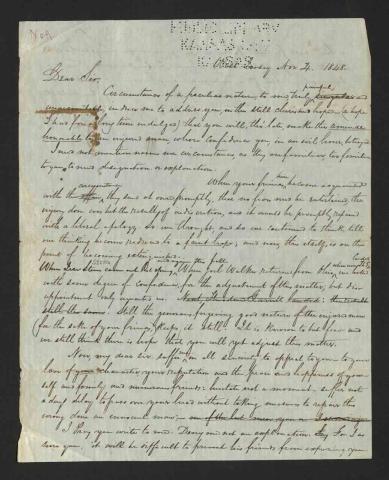
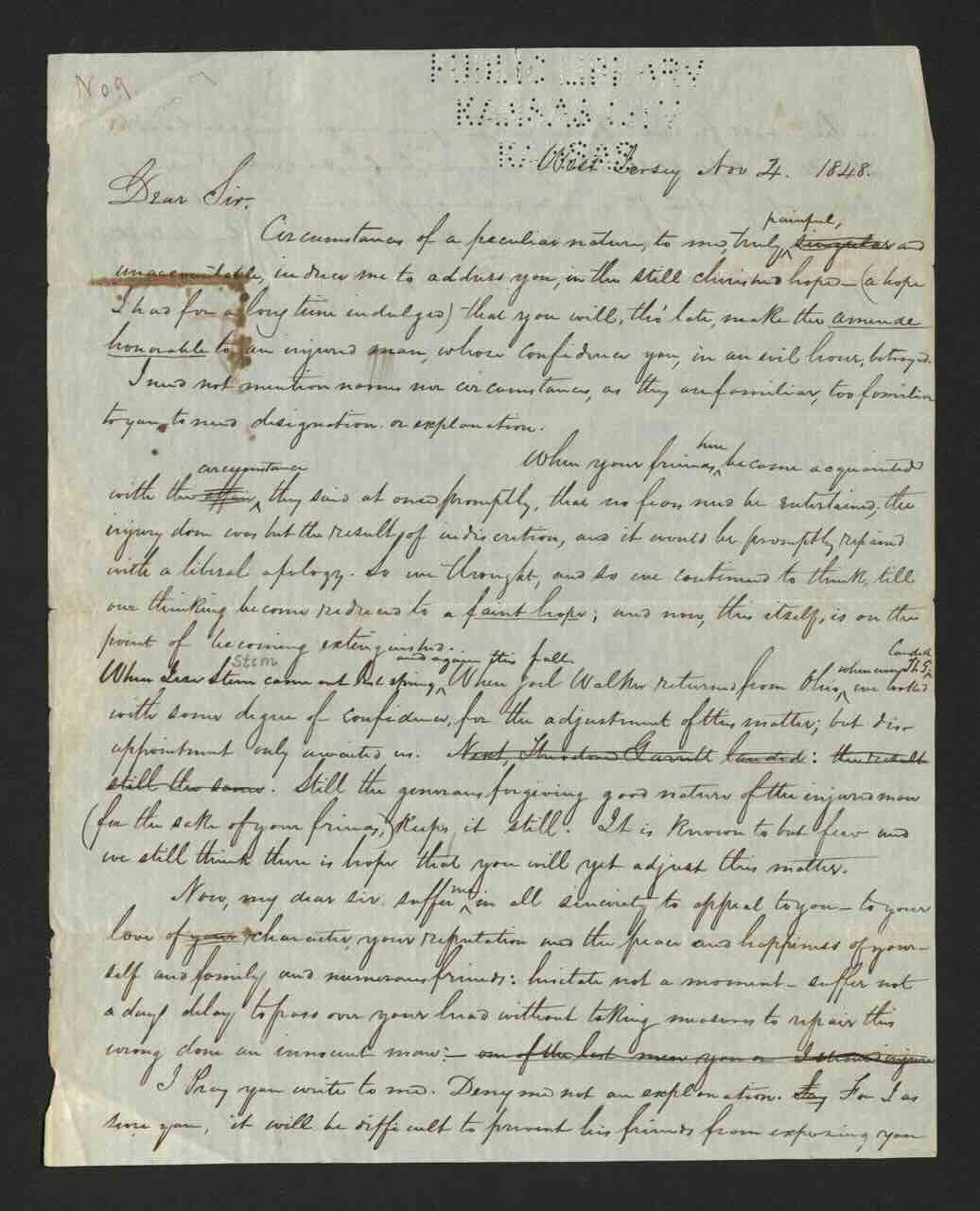
Letter from William Walker to unknown, West Jersey – November 4, 1848
Walker writers to an uspecified person regarding "circumstances of a peculiar nature, to me, truly painful". The context of the letter is entirely unclear, as Walker says that he "need not mention names nor circumstances, as they are familiar, too familiar, to you to need designation or explanation. Joel Walker, Theodore Garrett, and Lisa Stern [?] are mentioned in the letter. Walker expects a resolution to the matter within six weeks, or "it will be difficult to prevent his friends from exposing you in the worst possible form". Includes Connelley clipping.
Letter to Joel Walker from George Boyd, Kansas – January 10, 1850
Boyd writes mostly about business matters, mentioning that he is "not fond of running wrisks" and that he will be "holding off with the Wyandotts to some considerable extent". Also says that Mike McLeland has recently returned to Kansas from California, and has "set this country on fire on the gold subject and many talk of going this spring". "Nobody sick and no one dead since you left," but William Walker's son-in-law in Independence has gone blind. Connelley clipping included.
Letter to Joel Walker from H.M. Northrup, Kansas – January 19, 1850
Northrup shares some general news from "our little town," before sharing that Robataille has told him that the chief "has it in contemplation to to cut myself & family off from the benefits of the Nation … why it is that those whose blood mingles with the blood of my wife & offspring should wish to single them out for petty [marks of displeasure?] I am unable to conceive".
Letter to Joel Walker from John Wheeler, Homer, O. – February 25, 1850
Wheeler writes to Walker about a Council Order assigned to him stating the is owed a balance of about $800.00. William Walker has suggested that Wheeler contact the Wyandott delegation in Washington, and Wheeler hopes Joel Walker can assist him in that.
Letter to Joel Walker from William Walker, West Jersey – February 21, 1851
William is looking for a number of books related to Indian history, and asks his brother to enquire about them, "if, during your rambles in the East, you should happen to drop into any of the Book Stores".
Letter to Joel Walker from William Walker, The “Jarsey” – July 12, 1852
William is frustrated by "the great irregularity in the mail in this State," and tells Joel "I will remark by way of parenthisis, that you must have been severely pressed with business, to be in the City fourteen days before writing to your constituents." Fears that Joel's delegation to Washingon will be a failure and laments that "this Congress will long be remembered as 'the worthless Congress'". Mrs. Armstrong's pigs keep eating his corn, so he and Nicholas Nickelby killed 14 or 15 of them.
Letter to William Walker from Joel Walker, St. Louis – December 17, 1854
Joel is writing to his brother William about a recent, "tedious" journey he completed, and now he has a bad cold from "being thus exposed." Joel informs William that Major Robinson has been ordered to pay the surplus funds, and he hopes that the "chiefs will require him to do it immediately." Joel ends the letter by stating that he would like to hear from William, and he will not write again until he gets to Washington.
Letter to Joel Walker from William Walker, West Jersey – December 30, 1854
William received Joel's letter and is replying, but his right eye is "sorely afflicted" and he is only able to write "a few lines at a time." Joel's directions concerning the surplus funds will be followed the next time they see Major Robinson. William notes the George Garrett's name was omitted on the list of grantees, and he tells Joel that in this matter he can "act as you may deem best." William describes a fight in Kansas between McGee and Payne, "in which the former got an unmerciful thrashing." William would like Joel to have a private interview with Schoolcraft, and ask him some specific questions about Wyandott history. In the postscript to the letter, William mentions that Russell Garrett has received information from the squatters on the "river Blue" that they are raising strong objections to the Wyandotts being granted the lands along that river.
Letter to Joel Walker from William Walker – January 7, 1855
William notes that he is still afflicted in his right eye, but the condition is improving. William informs Joel that nothing of note has occurred recently, and everything is "tranquil and quiet." William has been "studying over a scheme" involving an old bank debt of Joel Boulingarne, and he would like Joel's advice on the matter. William notes that to treat his weak eye he was attempting a spare diet to "reduce the natural richness of the blood," but it was not working, so he abandoned it. Instead he is eating what he can get, and occasionally taking a glass of good liquor, and he is now improving. The Council is meeting tomorrow, and William hopes to have an "official state paper from the Delegation to lay before that body." Major Robinson has not paid the surplus fund yet, as he was called away to attend to the Surveyor who was "making surveys in the Delaware ceded Territory."
Letter to Joel Walker from William Walker, U. Sandusky – February 7, 1835
William says that everyone is well, and that things are happening at the "usual jog." William continues by noting that Nicholas Cotter is not expected to live, and that I. Chaffee's mill and distillery have been burnt to the ground. George Armstrong pronounced that his brother should receive a recommendation from the Council, but H. Jacquis listed the reasons why the Council would not grant that recommendation.
Letter to Joel Walker from William Walker, U. Sandusky – April 24, 1835
This document has two sections, the first of which is letter from William Walker Jr. to his brother Joel Walker. Within the letter, William tells Joel about the death of Chief Long and many other deaths that have occurred recently, saying that the departed have traveled to the "narrow house appointed for all flesh." William then tells Joel that in the election held last week that he was appointed chief, and he will serve out the remainder of the term created by the death of Chief Long. The second part of this document is written in pencil and concerns the Wyandotte constitution. The authorship of this section is unknown.
Letter to Joel Walker from William Walker, U. Sandusky – July 22, 1842
William tells Joel that he has received a letter from C. G. McHatton, special agent of the Post Office department, attempting to ascertain who would accept the Post Master's job if William did not keep it. William notes that he has "long petitioned for" an "increased allowance."
Letter to Joel Walker from William Walker, Upper Sandusky – August 12, 1842
William writes to Joel and lists the nominees that they have "agreed to support." If the treaty is confirmed and it is believed that the House of Representatives will make the appropriation, then the Chiefs and Head Chief will be elected for a term of two years. If the prospects are not favorable, then that will not be the case. William tells Joel that it is the general wish of the Council that he "hang on as long as there is a prospect of getting the appropriation made this session." William also notes that Harry is quite sick, and he has been up "nearly all night attending on him." William ends the letter by stating that he believes Governor Morrow might prevail upon the Commission on Indian Affairs and upon the Finance Committee, as he is a "general favorite with both bodies."
Letter to Joel Walker from William Walker, Upper Sandusky – August 15, 1842
William writes to Joel and notes that soon Joel will "bid adieu to the metropolis," and that he will be "heartily glad to get away from the filthy hole." Henry is still sick with the inflammatory rheumatism and the bilious remittent fever. The orator of the day and the manager of the election arrived this afternoon, even though the election is tomorrow. William will be looking "with confidence for a communication" from Joel that he will be able to read to the assembled nation.