
Letters from the Draper Collection



654A – Empty Envelope with Connelley writing
This is the envelope that contained the letters of William Walker Jr. and Peter D. Clarke from the Draper Manuscript Collection at the Wisconsin Historical Society.
654B – Letters from William Walker to Lyman C. Draper, 1852-1873
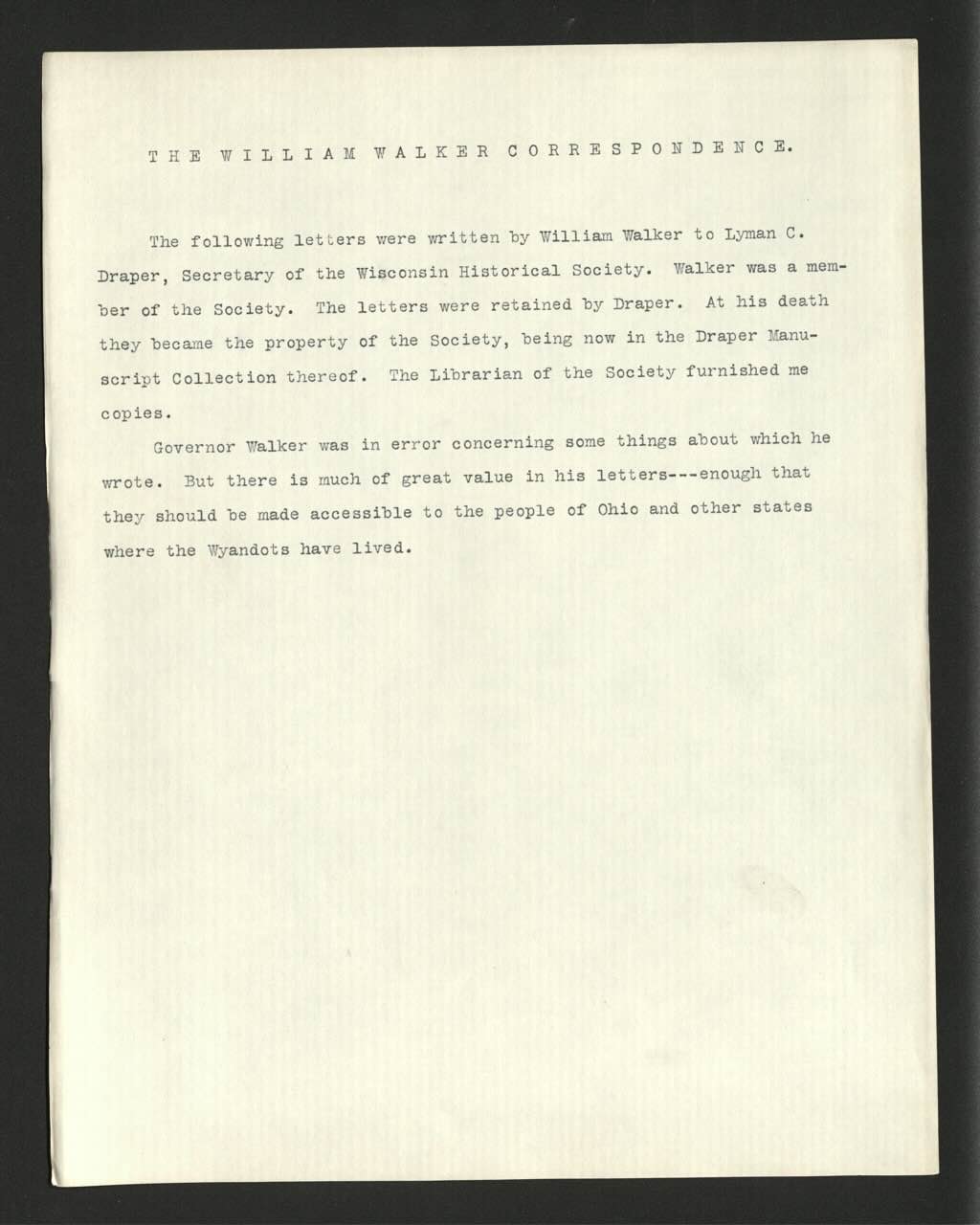
1925/00/00 Cover Page for the William Walker Jr. Correspondence with Lyman Draper
This is the cover page for the transcriptions of the William Walker Jr. correspondence with Lyman Draper. Connelley notes that Governor Walker was "in error concerning some things about which he wrote," but "there is much great value in his letters."
1852/02/13 William Walker Jr. to Lyman C. Draper
The first letter discusses Walker's struggle with Bilious Fever, and his attempts to gather important information about Abraham Kuhn. The second letter discusses Simon Girty. The third letter discusses Colonel William Crawford's campaign and death.
1857/08/25 William Walker Jr. to Lyman C. Draper
Walker Jr. apologizes for not providing the requested information, but he has been suffering from eye problems. Walker Jr. notes that he has been elected as a member of the Constitutional Convention for this "miserable and unfortunate territory." He has read the report that Draper sent, and he says that he was acquainted with "many of the actors in the drama."
1860/03/21 William Walker Sr. Biographical Sketch - First Series
This is the first part of a biographical sketch of William Walker Sr. written by his son and sent to Lyman C. Draper. Walker Sr. was born in 1770 near Green Brier, Rockbridge County, Virginia. In the summer of 1781, when he was 11, he was captured by a Delaware war party. During their captive march, Walker Sr. spoke to his Aunt about escape, but she objected, and they were eventually separated, and he never met her again. Eventually Walker Sr. was adopted into the Wyandot tribe by Adam Brown, and he lived with him until his marriage to Catharine Rankin. He settled near Brownstown in Wayne County, Michigan, and he lived there until the War of 1812.
1860/03/21 William Walker Jr. to Lyman C. Draper
In the first letter, Walker Jr. says that he is complying with Draper's request, and he has begun a "running sketch of my father's life." In the second letter, he has enclosed the second series of the life of William Walker Sr., and he notes that he has been unable to gather much information about Abraham Kuhn.
1860/03/28 William Walker Sr. Biograph Sketch - Second Series
This is the second part of a biographical sketch of William Walker Sr. written by his son and sent to Lyman C. Draper. Walker Sr. took part in the War of 1812, and was eventually captured. He escaped, and made his way to a fort of the American Army.
1862/06/04 William Walker Jr. to Lyman C. Draper
In the first letter, Walker Jr. writes that he will attend to the questions about Captain Snake when the opportunity presents itself. He will also attempt to find "some suitable persons as correspondents among the Shawnees and Delawares." In the second letter, Walker Jr. states that he is having eye problems again and cannot do much writing. He also advises Draper to "keep a good stock of credulity by you while reading Finley's works."
1867/11/16 William Walker Jr. to Lyman C. Draper
Walker Jr. states that he has received Draper's letters concerning prominent Wyandotts, and he will attend to them when he has reliable data to report. Walker Jr. is attempting to find out more information about Abram Kuhn, and he can also provide details about the life of Scotush. Walker Jr. is awaiting the return of Tauromee, who he believes will have some valuable items of information.
1870/00/00 Biographical Sketch of Abram Kuhn
This is a biographical sketch of Abram Kuhn, who was captured by a war party of Wyandotts around 1770. Walker Jr. does not believe that Kuhn was involved in St. Clair's defeat, but he was in Wayne's Battle on the Maumee River in 1794. Kuhn also helped to bring about Wayne's Treaty of 1795. Kuhn died at Lower Sandusky, and Walker Jr. concludes by noting that he is the guardian of his grandson, Geo. A. Kuhn.
1871/11/09 William Walker Jr. to Lyman C. Draper
In the first letter, Walker Jr. discusses the life of Abram Kuhn, and notes that on this subject his "gleanings are very meagre." In his postscript, Walker Jr. notes that if his vision was better he could "write you much historical matter of the stirring times of the last century." In the second letter, Walker Jr. discusses an absence of eight months, and he hopes that Draper had a good trip down South. In the third letter, Walker Jr. discusses his return from Ohio, and a sickness that he brought home with him. While in Eastern Ohio, Walker Jr. attempted to "collect some items relative to the old border war," but he did not have much success except for a siege involving a wooden cannon. In the final letter, Walker Jr. is asking Draper about Simon Girty, and whether or not he had any sons.
1872/05/04 William Walker Jr. to Lyman C. Draper
Walker Jr. relates the story of the Wooden Cannon, which killed one Wyandott and severely wounded several others. The men who employed the wooden cannon agreed to "keep this wooden cannon disaster a profound secret on reaching home as they would be subjected to perpetual ridicule if known." However, the secret came out during Wayne's Treaty of 1795.
1868/07/00 William Walker Jr. to Lyman C. Draper
Walker Jr. writes about Wyandott history, touching on the subjects of horses, cattle, St. Clair's Defeat, Simon Girty, Jim Girty, Colonel William Crawford, Abram Kuhn, the Half King, and Poe's Fight.
1854/11/29 William Walker Jr. to Charles N. Allen
Walker Jr. is writing to Allen regarding an article in the Democratic Sentinel entitled "The Indian Chief, Rhonuness." Walker Jr. would like to "take this occasion to pronounce that part which relates to Rhonuness' employment and his expedition to Poe's dwelling, untrue!" Walker Jr. believes that the article in question is more fiction than truth.
1868/06/29 William Walker Jr. to Lyman C. Draper
Walker Jr. writes about Wyandott history, touching on the subjects of Rhonuness, the Lick Defeat, the Brownstown Conference, the War of 1812, Tecumseh, Adam Brown, Between-the-Logs, Lumpy, Walk-in-the-Water, and Simon Girty.
1868/07/06 William Walker Jr. to Lyman C. Draper
Walker Jr. writes about Wyandott history, touching on the subjects of Adam Brown, Tecumseh, Isadore Chene, Simon Girty, Tarhee, Abraham Kuhn, Wyandott Clans, Delawares, the Embassy of June, 1813, Colonel William Crawford, the Brownstown Wyandotts, the Poe Fight, and Estill's Fight.
1870/10/19 William Walker Jr. to Lyman C. Draper
Walker Jr. is responding to a Draper letter and provides some information on the Michigan Wyandotts during the War of 1812. Walker Jr. also touches on a number of subjects like Tecumseh, Isadore Chene, Round Head, Scootash, and Colonel William Crawford. In a postscript, which Walker Jr. notes is personal, he describes the death of his wife from malignant Flux. After this, Walker Jr. left Kansas for Arkansas and stayed "among the tribes of Indians, and the still wilder white people of Arkansas & Missouri." Walker Jr. would like to travel to Ohio in the winter to stay with his step-daughter, Mrs. Clement, who was his wife's only child.
1870/12/19 William Walker Jr. to Lyman C. Draper
Walker Jr. is writing to Draper on the subject of Schotush, and about his involvement in the murder of Leather Lips. Walker Jr. believes that the "executioner was Peter Gould," and that "Round Head had nothing to do with the murder."
1870/12/26 William Walker Jr. to Lyman C. Draper
In the first letter, Walker Jr. is informing Draper that Peter D. Clarke is now in the Cherokee Nation. In the second letter, Walker Jr. admits that he has failed in his inquiries relating to the Scotush mystery, except for the fact that the Half King was not Scotush's father. With the death of Adam Brown, Walker Jr. states that he is now the oldest living Wyandot male. In the third letter, Walker Jr. discusses the subjects of Simon Kenton, White Eyes, Captain Pipe, and the Delawares. In the last letter, Walker Jr. is thanking Draper for sending him information on Chief White Eyes.
1871/03/27 William Walker Jr. to Lyman C. Draper
Walker Jr. is attempting to recreate a "lost letter" that he sent to Draper in the past. Walker Jr. spoke with John D. Brown regarding Scotush's paternity, and Brown stated that Scotush was "illegitimate." Walker Jr. also states that Scotush was not involved in the murder of Chief Leather Lips.
1870/11/01 William Walker Jr. to Lyman C. Draper
In the first letter, Walker Jr. informs Draper that he has found the "missing No. and hasten to forward to you." In the second letter, Walker Jr. tells Draper that he has been sick, and that is the reason it has taken so long to answer the questions.
1870/11/00 William Walker Jr. to Lyman C. Draper
In this document, entitled "Memorandum," Walker Jr. discusses a number of subjects, such as Spliced Arrow, Samuel Rankin, Colonel Stone, and Joseph Brant.
1870/11/22 William Walker Jr. to Lyman C. Draper
Walker Jr. is writing to Draper about a passage that he read that stated that "Tecumseh could read and write." Walker Jr. says that this is "one of the baldest & unmitigated fabrications I ever knew to be found in a history of respectable pretensions." Walker Jr. states that Tecumseh could speak neither English nor French, and he tells Draper this because he feels that "the truth of history should be vindicated."
1870/12/07 William Walker Jr. to Lyman C. Draper
Walker Jr. writes about several subjects, including Walk in the Water, Cherokee Boy, the Southern Mission, and Billy Caldwell.
1870/12/15 William Walker Jr. to Lyman C. Draper
In this document, entitled "Notes on Clark's Wyandott History," Walker Jr. notes that Adam Brown was not a Chief, and he believes that the Brant conspiracy section is substantially true. Walker Jr. also mentions Tecumseh, White Eyes, and Reverend James B. Finley.
1873/06/07 William Walker Jr. to Lyman C. Draper
Walker Jr. is writing to Draper from the Oklahoma Territory, where he has been appointed as delegate to represent the Wyandott people. Walker Jr. notes that the Treaty of 1867 "stands to this day unfulfilled."
1874/09/10 Josephine E. Smalley to Lyman C. Draper
In this letter Josephine Smalley informs Draper that her uncle William Walker Jr. died at her residence in Kansas City on February 12 of typhoid-pneumonia. Smalley notes that Walker Jr. "left manuscripts, his diary, and various notes, that might be of importance to some historians, but nothing in form to publish."
1870/06/24 Wyandott Chiefs at Muskingum Treaty
This document discusses the parents of William Walker Jr. and the Treaties of 1855 and 1867.